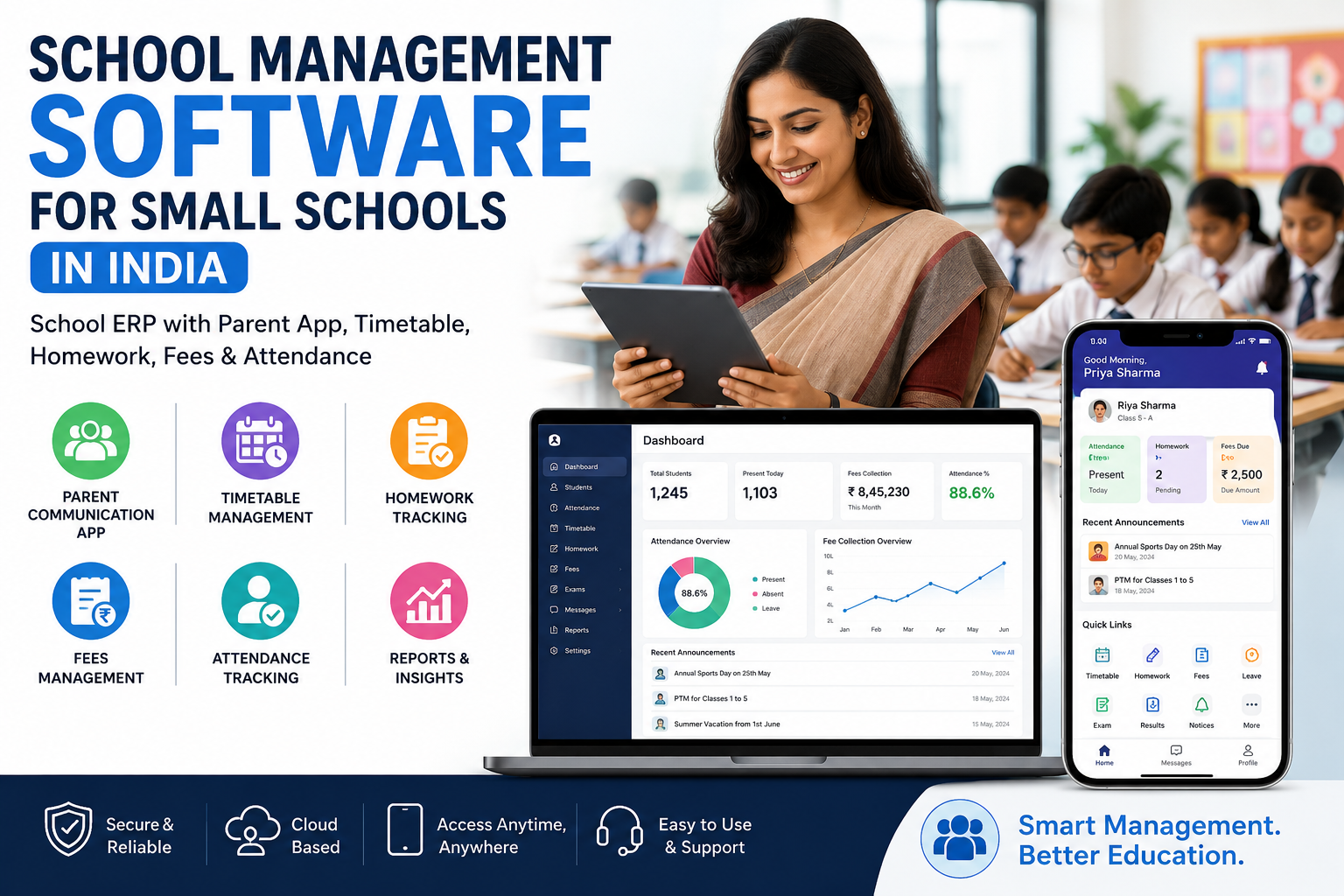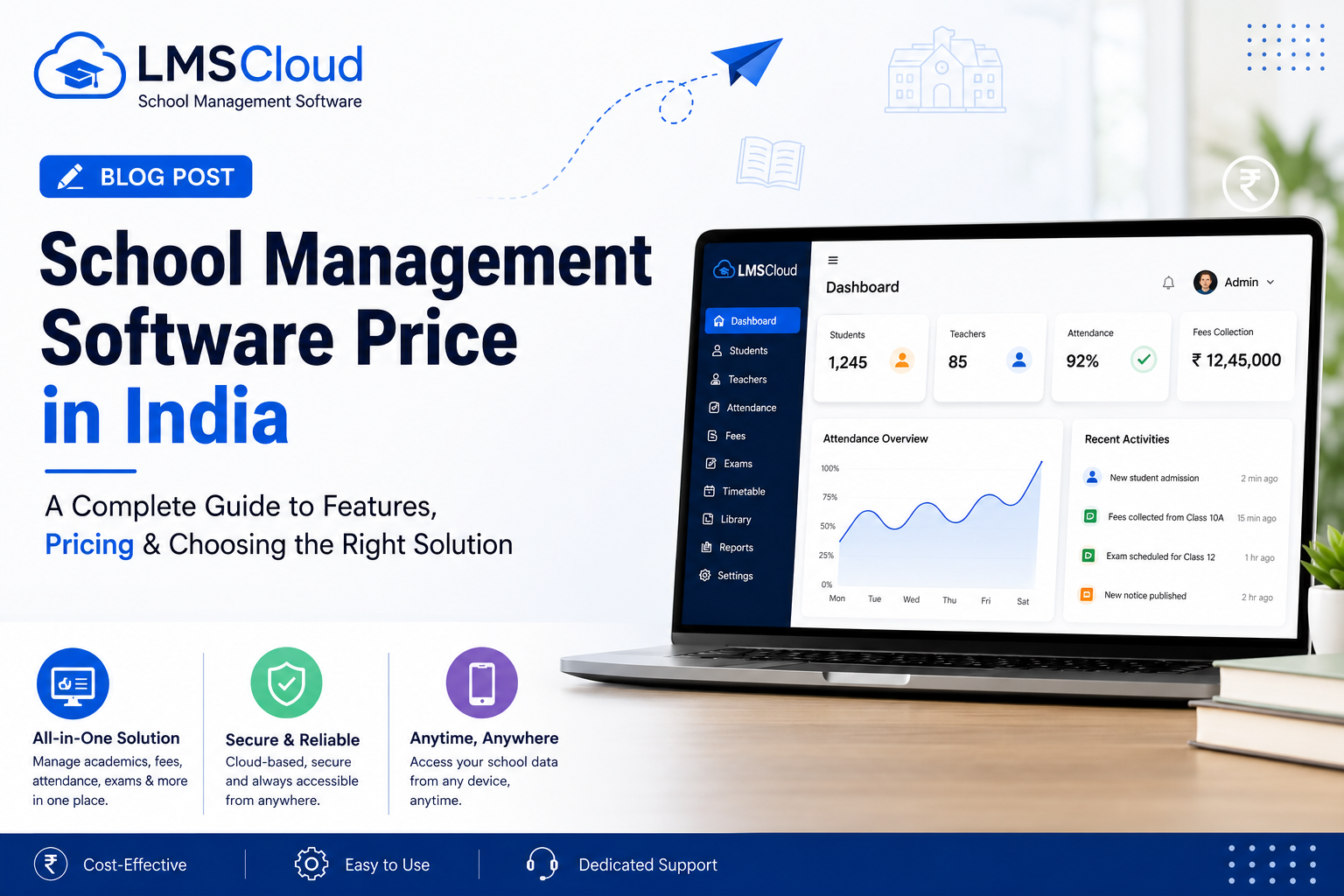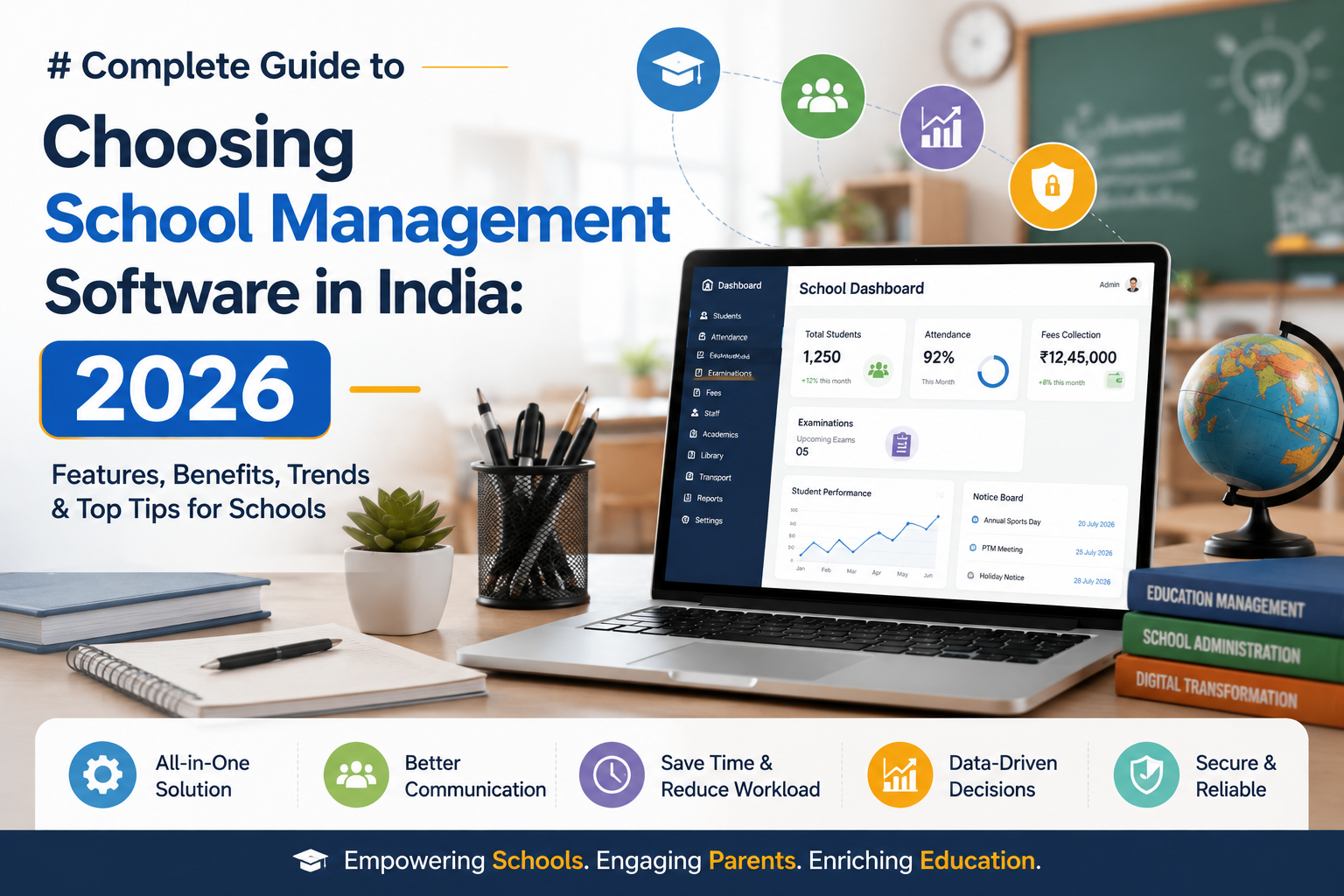
School management software in India streamlines attendance, academics, exams, and fees in one platform. Most Indian schools spend ₹10,000-35,000 annually for complete solutions. Cloud-based systems reduce administrative burden by 40-60% and improve teacher-parent communication instantly.
Why Indian Schools Need Digital Management Systems Now
Indian education has transformed fundamentally over the past five years. Schools that still track attendance in registers, send fee reminders through WhatsApp, and build timetables manually face operational inefficiency that directly impacts student learning outcomes.
The shift toward digital school management isn't optional anymore. Here's why Indian schools specifically need structured solutions today.
Administrative Burden Reduction
A principal at a 300-student school spends approximately 15-20 hours weekly on administrative tasks: attendance verification, fee collection tracking, timetable management, and parent communication. Digital school management software reduces this to 2-3 hours. That time translates to strategic planning, student engagement, and teaching quality improvements.
Government Compliance Requirements
Indian schools must comply with multiple regulatory requirements: NEP guidelines, safety protocols, attendance thresholds, and mandatory report submissions to education boards. Manual systems create compliance risks and audit delays. Digital systems generate compliant reports automatically.
Parent Expectations and Communication
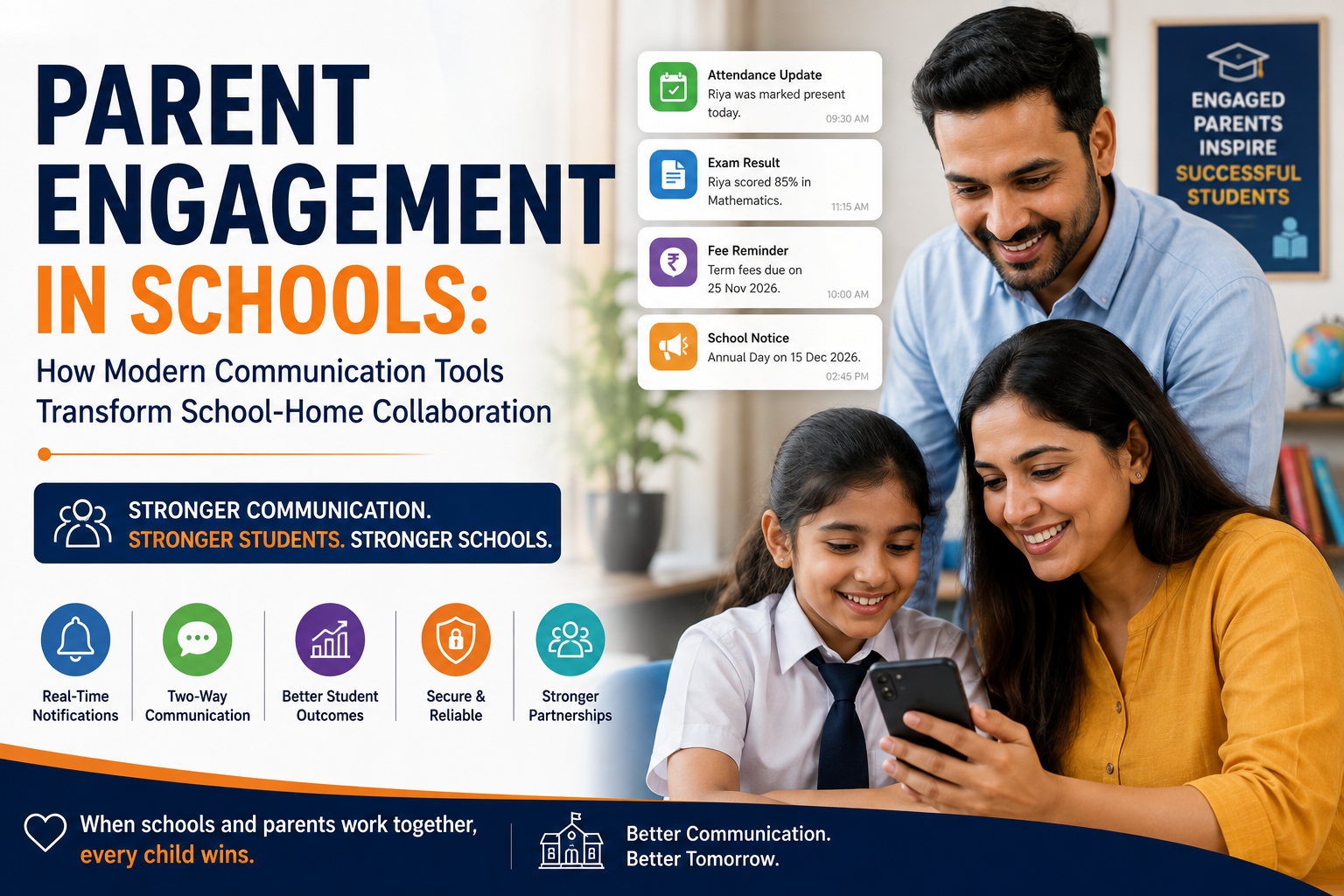
Modern parents demand instant updates on student attendance, assignments, exam results, and school announcements. Email and WhatsApp groups lack accountability and record-keeping. Structured school management platforms provide transparent, verifiable communication channels that build parent trust.
Competitive Educational Advantage
Schools advertising modern management systems attract better quality students and higher fee collections. Digital infrastructure signals quality, safety, and transparency to prospective parents. This becomes crucial in competitive urban and semi-urban markets across India.
Data-Driven Decision Making
Which classes underperform academically? Which teachers need support? Which fee categories have the highest non-collection? Manual systems can't answer these questions quickly. Digital platforms provide instant analytics that inform better institutional decisions.
Understanding School Management Software vs School ERP vs LMS
Confusion exists among Indian schools about software terminology. Understanding distinctions helps you select the right solution.
School Management Software
Definition: Handles administrative operations and student information management.
Includes: Student admission, fee management, attendance, leave tracking, staff management, timetables, announcements.
Best for: Schools focused on reducing administrative burden and improving operational efficiency.
Example use case: A 200-student private school seeking to eliminate paper-based processes.
School ERP (Enterprise Resource Planning) Software
Definition: Comprehensive platform integrating academics, administration, finance, and human resources into unified system.
Includes: Everything in management software PLUS lesson planning, assignment management, exam result analysis, performance tracking, integrated website, and advanced financial reporting.
Best for: Schools wanting complete digital transformation across all departments.
Example use case: A 500+ student institution requiring advanced exam management and detailed performance analytics.
Learning Management System (LMS)
Definition: Focused primarily on online learning, content delivery, and student-teacher academic interaction.
Includes: Online lessons, assignment submission, online exams, discussion forums, resource libraries.
Best for: Schools conducting online/hybrid classes or offering distance learning programs.
Example use case: During pandemic periods or schools offering online supplementary programs.
Reality for Indian schools: Most effective solutions combine school management, ERP, and LMS capabilities. Modern school management software now includes all three components.
Current School Management Software Pricing in India (2026)
Transparent pricing helps Indian school principals budget accurately. Here's what different solution tiers cost.
|
Solution Type |
Student Capacity |
Annual Cost (INR) |
Best For |
Key Features Included |
|
Basic Starter |
50-200 students |
₹10,000-15,000 |
Small schools, single campus |
Student management, attendance, timetable |
|
Standard |
200-500 students |
₹19,000-25,000 |
Growing institutions |
Fees, exams, assignments, staff management |
|
Premium/Complete |
500-1000 students |
₹35,000-60,000 |
Large schools, multiple campuses |
All features + transportation, staff leave, expense tracking |
|
Enterprise/Custom |
1000+ students |
₹80,000-2,00,000+ |
Large chains, special requirements |
Full customization, dedicated support, API integration |
Hidden costs to account for:
-
Implementation and data migration: ₹5,000-20,000 (one-time)
-
Staff training sessions: ₹3,000-10,000 (one-time)
-
Customization for school-specific processes: ₹5,000-50,000
-
Email support beyond business hours: ₹5,000-15,000 annually
-
Integration with existing accounting software: ₹5,000-25,000
Transparent pricing advantage: Quality school management software providers display all-inclusive pricing without surprise fees during contract renewal.
15 Essential Features for Indian School Management Software
Not all features matter equally to every school. However, these 15 features represent minimum requirements for comprehensive school management in India.
Core Academic Features
1. Student Management System
-
Admission form creation and processing
-
Bulk student import capability
-
Parent and guardian details management
-
Emergency contact information tracking
-
Medical history and allergy records
Why it matters: Single source of truth for student information reduces administrative errors and improves safety protocols.
2. Attendance Management
-
Daily class-wise attendance marking
-
Automatic low-attendance alerts to parents
-
Leave tracking with approval workflow
-
Monthly attendance reports
-
SMS/app notifications for absent students
Why it matters: Tracks regulatory compliance (80% attendance requirements) and identifies at-risk students early.
3. Online Exam Management
-
Exam scheduling across classes and divisions
-
Question paper distribution to teachers
-
Online and offline exam result entry
-
Automated report card generation
-
Subject-wise performance analytics
Why it matters: Simplifies exam processes, speeds result declaration, enables quick performance analysis.
4. Assignment and Lesson Management
-
Online assignment creation and distribution
-
Digital assignment submission by students
-
Teacher feedback and grading
-
Lesson planning and topic division
-
Resource attachment (PDFs, videos, links)
Why it matters: Supports blended learning, creates permanent academic records, reduces paper usage.
5. Timetable Management
-
Automated timetable generation
-
Class-wise teacher scheduling
-
Subject allocation management
-
Holiday calendar integration
-
Free period visibility for teachers
Why it matters: Eliminates scheduling conflicts, saves hours of manual work, enables quick adjustments.
Administrative Features
6. Fee Management and Accounting
-
Multiple fee category management
-
Automatic fee reminders and receipts
-
Online payment gateway integration
-
Discount and concession tracking
-
Monthly financial reporting
Why it matters: Reduces fee collection delays, improves cash flow, simplifies accounting.
7. Staff Leave Management
-
Leave application and approval workflow
-
Different leave types (casual, sick, earned)
-
Leave balance tracking
-
Leave period blocking on timetables
-
Staff attendance records
Why it matters: Maintains institutional continuity, tracks compliance with labor rules.
8. Staff Information Management
-
Staff database with qualifications
-
Role-based permission assignment
-
Performance tracking capability
-
Salary and payroll details (optional integration)
-
Document storage (certificates, ID proofs)
Why it matters: Centralizes HR information, enables proper staff utilization planning.
Communication Features
9. Real-Time Announcements
-
School-wide or class-specific announcements
-
Image and document attachment capability
-
SMS/email/app push notifications
-
Parent and student access
-
Announcement archiving for records
Why it matters: Ensures important messages reach all stakeholders instantly, eliminates miscommunication.
10. Parent-Teacher Communication Module
-
Direct messaging between parents and teachers
-
Threaded conversations for clarity
-
Read receipts and message history
-
Scheduled message sending
-
Multi-language support
Why it matters: Bridges home-school gap, creates transparent communication trail, reduces WhatsApp dependency.
Parent and Student Portal Features
11. Parent Application Access
-
Real-time attendance visibility
-
Exam results and performance reports
-
Assignment status and marks
-
Fee payment status and reminders
-
School announcements and updates
-
Direct teacher communication
Why it matters: Parents stay informed, payment reminders reduce fee collection burden, demonstrates school transparency.
12. Student Portal Access
-
Personal timetable and schedule
-
Subject lessons and study materials
-
Assignment submissions
-
Exam results and performance analysis
-
School announcements
-
Transportation tracking (if applicable)
Why it matters: Encourages student engagement, enables self-service access to academic information, reduces office queries.
Infrastructure Features
13. Mobile Application Support
-
iOS and Android native apps
-
Offline mode for attendance and marks
-
Push notifications for updates
-
Responsive web version
-
Synchronized data across devices
Why it matters: Teachers mark attendance offline (critical during network issues), parents access information anywhere.
14. Data Security and Backup
-
Cloud-based encrypted storage
-
Daily automatic backups
-
User role-based access control
-
Two-factor authentication
-
GDPR/data protection compliance
Why it matters: Protects sensitive student and school data, prevents unauthorized access, meets regulatory requirements.
15. Website Management Integration
-
School website hosting and management
-
Automatic data synchronization
-
Online admission form functionality
-
Event calendar and notice board
-
Search engine optimization built-in
Why it matters: Reduces website maintenance costs, keeps online presence automatically updated, improves school visibility.
How School Management Software Solves Real Indian School Problems
Understanding how software addresses specific pain points helps schools justify investment.
Problem 1: Fee Collection Delays
Reality: Indian schools typically collect 60-70% of fees on time. Delays create cash flow problems and budget uncertainty.
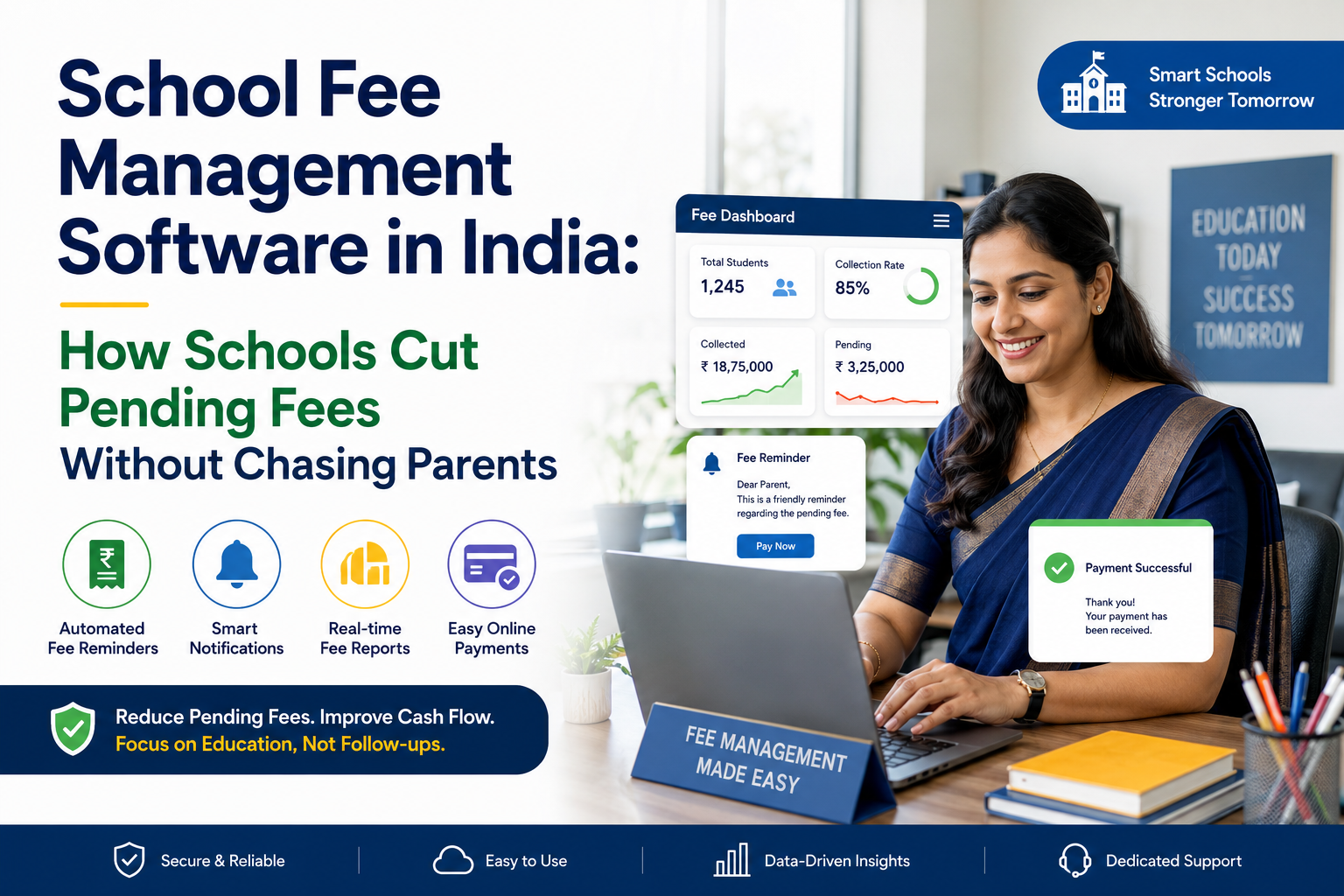
Software solution: Automated fee reminders via SMS and app notifications, online payment gateway integration, digital receipts, fee installment tracking, automatic escalation to principals after set delays.
Impact: Schools report 15-25% improvement in on-time collections within 3 months.
Problem 2: Attendance Accuracy and Compliance
Reality: Manual attendance marking is prone to errors. Government requires 80% attendance compliance documentation.
Software solution: Digital attendance marking, automatic parent notifications for absences, exception reports for low-attendance students, monthly compliance reports for board submission.
Impact: Improves attendance verification accuracy by 95%, eliminates manual report compilation (saves 5-10 hours monthly).
Problem 3: Exam Management Complexity
Reality: Coordinating exam schedules, question paper distribution, result compilation, and report card generation takes 2-3 weeks per exam cycle.
Software solution: Centralized exam scheduling, teacher access for result entry, automated report card generation, performance analytics by subject and class.
Impact: Reduces exam cycle duration from 21 days to 5-7 days.
Problem 4: Parent-School Communication Gaps
Reality: Important messages sometimes don't reach all parents. Miscommunication creates confusion and trust issues.
Software solution: Structured announcement system with read receipts, direct messaging channels, multi-language support, searchable message history.
Impact: Ensures 98%+ message delivery, eliminates "I didn't know" complaints, builds parent satisfaction.
Problem 5: Teacher Administrative Overload
Reality: Teachers spend 3-4 hours weekly on non-teaching administrative tasks (attendance, marks entry, assignment tracking).
Software solution: Simplified digital attendance and marks entry, automated assignment distribution, centralized lesson planning, single dashboard for all responsibilities.
Impact: Recovers 2-3 hours weekly per teacher for actual teaching and student interaction.
Problem 6: Inadequate Performance Analytics
Reality: Schools can't quickly identify struggling students, weak teaching areas, or curriculum effectiveness issues.
Software solution: Real-time performance dashboards, subject-wise analytics, student-wise progress tracking, comparison reports across classes and years.
Impact: Enables targeted interventions, identifies at-risk students within days instead of months.
Selecting School Management Software: Essential Checklist
Use this checklist when evaluating different school management software options for your institution.
Functionality Evaluation
-
[ ] Does it include all 15 essential features for your school size?
-
[ ] Can it scale as your school grows?
-
[ ] Does it support multiple classes, sections, and streams?
-
[ ] Can timetables be created automatically?
-
[ ] Does exam management match your school's specific process?
-
[ ] Are reports customizable to your requirements?
-
[ ] Does it integrate with your current accounting software?
User Experience and Adoption
-
[ ] Is the interface intuitive for teachers with limited tech skills?
-
[ ] Can parents and students navigate the portal easily?
-
[ ] Is training provided to staff during implementation?
-
[ ] Are help videos and documentation available?
-
[ ] Is customer support responsive (email, phone, chat)?
-
[ ] Is there a demo available before purchase?
Technical Requirements
-
[ ] Is it cloud-based (no server installation needed)?
-
[ ] Does it work on phones, tablets, and computers?
-
[ ] Is offline functionality available for critical features?
-
[ ] What bandwidth requirements exist?
-
[ ] Is data regularly backed up?
-
[ ] What happens to your data if you switch vendors?
Security and Compliance
-
[ ] Is student data encrypted?
-
[ ] Are there role-based access controls?
-
[ ] Is two-factor authentication available?
-
[ ] Does it comply with Indian data protection requirements?
-
[ ] Is there a privacy policy addressing student data use?
-
[ ] Are audit trails maintained for sensitive transactions?
Cost Transparency
-
[ ] Is the pricing all-inclusive or are there hidden fees?
-
[ ] What does implementation cost?
-
[ ] Are ongoing support and updates included?
-
[ ] Is there a minimum contract period?
-
[ ] What is the cancellation and refund policy?
-
[ ] Are there discounts for multi-year commitments?
Vendor Reliability
-
[ ] How long has the company been operating?
-
[ ] How many Indian schools use their solution?
-
[ ] Are there references from similar-sized schools?
-
[ ] Does the company have local support staff?
-
[ ] What is their response time for technical issues?
-
[ ] Do they provide updates and new features regularly?
Implementation Timeline: What to Expect
Understanding the implementation process helps schools plan resource allocation and transitions.
Week 1-2: Onboarding and Setup
School responsibilities:
-
Assign internal point person for coordination
-
Gather school structure information (classes, sections, subjects, periods)
-
Provide staff details and organizational chart
-
Share existing student database (if available)
Vendor responsibilities:
-
Create school account and admin access
-
Configure basic school structure
-
Schedule staff training sessions
-
Set up payment gateway integration
Week 3-4: Data Migration and Staff Training
School responsibilities:
-
Share student, staff, and fee data in required format
-
Conduct staff training sessions (attend 90% mandatory)
-
Test core features on pilot data
-
Prepare holiday calendar and special dates
Vendor responsibilities:
-
Import and validate data accuracy
-
Provide hands-on training for administrators
-
Conduct separate training for teachers
-
Test all features with school's data
Week 5-6: Trial Period and Refinements
School responsibilities:
-
Run parallel operations (manual and digital)
-
Report any issues or feature requests
-
Complete parent and student account setup
-
Test communication features with actual messages
Vendor responsibilities:
-
Address reported issues quickly
-
Make necessary customizations
-
Conduct go-live preparation meeting
-
Finalize all configurations
Week 7: Official Go-Live
School responsibilities:
-
Execute full transition to software
-
Continue parallel operations for 1-2 weeks for safety
-
Provide feedback on issues
-
Gradual transition for different modules
Vendor responsibilities:
-
Monitor system closely for issues
-
Provide extended support during transition
-
Address issues within 24 hours
-
Conduct post-go-live review meeting
Typical timeline: Most schools go live within 5-7 working weeks with proper data preparation.
Top School Management Software Solutions Available in India
Several quality solutions serve Indian schools. Here's an objective comparison of options.
|
Solution |
Best For |
Annual Cost |
Strength |
Limitation |
|
Small to mid-size schools |
₹10,000-35,000 |
Affordable, easy to use, quick setup |
Limited customization for large schools |
|
|
Traditional ERP vendors |
Large schools, multiple campuses |
₹50,000-2,00,000+ |
Comprehensive, highly customizable |
Complex, steep learning curve, expensive |
|
Regional solution providers |
Specific state requirements |
₹15,000-50,000 |
Local support, regional compliance |
Limited scalability beyond region |
|
International solutions |
Schools wanting global standards |
₹1,00,000+ |
Advanced features, quality support |
Overkill for small schools, expensive |
Frequently Asked Questions About School Management Software
How long does implementation typically take?
Most schools go live within 5-7 working days for basic features. Full implementation including staff training and data migration takes 4-6 weeks depending on data quality and school complexity.
Can the software handle multiple campuses?
Yes, modern school management platforms support multi-campus operations. Administrators can manage different campuses from centralized dashboards while keeping data separate or combined as needed.
What if teachers don't know technology?
Quality vendors provide comprehensive training for non-technical staff. Most teachers learn core functions (attendance, marks entry) within one training session. Software should have intuitive interfaces that don't require tech expertise.
Is our existing data safe during migration?
Reputable vendors handle data migration with extreme care. They validate data accuracy, perform trial imports, and maintain your original data as backup. Always ask about their data backup and recovery procedures before signing.
Can parents access the system from their phones?
Yes, dedicated mobile applications and responsive web interfaces allow parents to access information anytime. Apps work both online and offline, with automatic synchronization when connectivity returns.
What happens if we switch to a different software later?
Before purchasing, request that your data be provided in standard formats (CSV, Excel) that another vendor can import. Avoid proprietary formats that lock your data. Most ethical vendors will provide your data in portable formats.
Is there ongoing cost beyond the annual subscription?
Basic subscription covers core features and support. Additional costs may include customizations (₹5,000-50,000), advanced modules (₹5,000-20,000 each), premium support (₹10,000-30,000 annually), or integration with external systems (₹5,000-25,000).
How secure is student data?
Quality solutions use cloud-based encrypted storage with role-based access controls. Ask vendors specifically about data encryption, backup procedures, compliance with Indian data protection rules, and their security certifications.
Can the software grow with my school?
Yes, cloud-based solutions scale easily. A vendor supporting 200 students can typically accommodate 2000+ students without infrastructure changes. Verify scalability with your vendor before purchase.
What if we face technical issues?
Most vendors offer email, phone, and sometimes chat support during business hours. Premium plans may include extended support hours. Before purchasing, verify response times for different issue severity levels.
Making Your Decision: Key Takeaways
Choosing school management software is one of the most important technology decisions Indian schools make. Your decision impacts administrative efficiency, teacher productivity, parent satisfaction, and student learning outcomes for years.
Critical decision factors:
-
Start with your actual needs, not feature lists. What problems does your school face now?
-
Prioritize ease of use over extensive features. A simple, usable system beats a complex one teachers avoid.
-
Ensure transparency in pricing and implementation. Avoid vendors with hidden costs or unclear processes.
-
Verify vendor reliability through references from similar schools, not just promotional claims.
-
Confirm data ownership. Ensure you can access your data in standard formats anytime.
-
Test before committing. Use free trials or demos extensively before final purchase decision.
Ready to Transform Your School Management?
Modern school management software transforms how Indian schools operate. Hundreds of schools already manage attendance, academics, and communication digitally instead of manually.
The investment typically returns itself within 6 months through reduced administrative time, improved fee collections, and parent satisfaction improvements.
Schedule a free demonstration to see how digital school management works specifically for your institution. Our team can answer questions about features, pricing, implementation, and help you understand whether now is the right time for your school.
Request a free demo and consultation