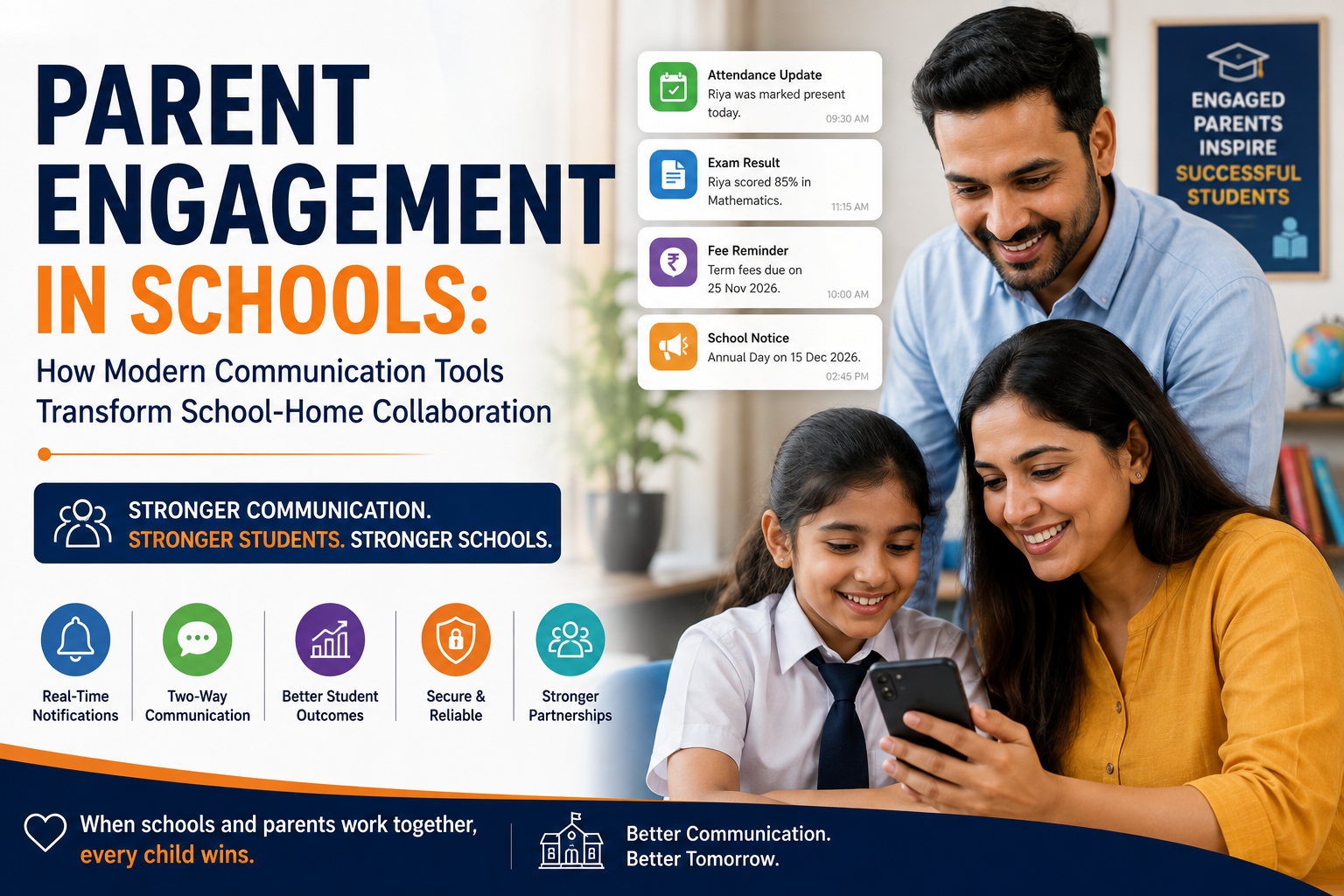
Parent Engagement in Schools: How Modern Communication Tools Transform School-Home Collaboration
A principal in Mumbai texted me recently: "We send attendance updates every day, yet parents claim they don't know about low attendance. They miss fee reminders. They find out about exam schedules from other parents, not us. Our communication system is broken."
She's not alone. Across India, schools struggle with parent engagement. Research shows that 62% of parents feel disconnected from their child's school, even though 78% want regular updates. The gap isn't about wanting communication. It's about how schools deliver it.
This isn't a problem modern schools can ignore. Parent engagement directly impacts student retention, academic performance, and even school referrals. Schools with strong parent communication see 23% higher student attendance and significantly lower dropout rates.
The solution isn't sending more emails or making more calls. It's using the right digital communication channels that parents actually check.
Why Parent Engagement Matters: The Real Impact on Schools
Parent engagement isn't a nice-to-have feature. It's a business driver for school growth and student success.
Impact on Student Performance: Students whose parents stay informed and involved show 15-20% improvement in academic performance. When parents receive regular updates on assignments, exam results, and attendance, they can intervene early if a child struggles.
Impact on Attendance and Dropout Rates: Schools with strong parent communication experience 18-25% improvement in daily attendance. Parents who receive timely notifications about absent days take corrective action faster. Early intervention through parent communication prevents dropouts before they happen.
Impact on Fee Collection: Schools that communicate fee dues proactively see 40% faster fee realization. When parents receive multiple reminders through their preferred channels, payment delays drop significantly.
Impact on School Growth: Parents engaged in school operations become advocates. 71% of satisfied parents refer the school to others. Strong parent communication directly drives admission inquiries and enrollment growth.
Real Number from Indian Schools: A school network across Delhi, NCR, and Mumbai tracking parent engagement found that schools using digital communication platforms saw:
-
34% increase in timely fee payments
-
28% reduction in student absenteeism
-
45% improvement in parent satisfaction scores
-
19% increase in referral-driven admissions
Current Challenges: Why Schools Struggle With Parent Communication
Understanding the problem is the first step to fixing it.
Challenge 1: Information Fragmentation Most schools communicate through multiple channels: WhatsApp groups, email, SMS, phone calls, notices on the gate. Parents miss updates because information is scattered. A parent might check WhatsApp but miss the email with exam schedule.
Challenge 2: One-Way Communication Schools announce. Parents receive. When a parent has a question or concern, they don't know who to reach. This creates frustration and reduces trust.
Challenge 3: Delayed Information A student is absent on Monday. The notice reaches the parent on Wednesday via a phone call. By then, the absence has already impacted attendance records. Timely communication requires real-time systems, not manual processes.
Challenge 4: Language Barriers In India, schools serve multilingual communities. Communication in English only excludes non-English speaking parents. Hindi, regional languages, and vernacular communication are essential but difficult to maintain manually.
Challenge 5: Lack of Personalization A parent wants information about their child. Instead, they receive announcements relevant to other students. Generic communication reduces engagement.
Challenge 6: No Record of Communication When disputes arise about who knew what and when, schools have no proof of communication. "We sent a notice" becomes problematic when the parent claims they never received it.
Challenge 7: Teacher Time Drain Teachers spend 8-10 hours weekly on parent communication via calls, messages, and emails. This diverts time from lesson planning and student instruction.
How Modern Communication Platforms Solve Parent Engagement
Digital school communication platforms built specifically for schools address every challenge above.
Real-Time Notifications
Parents receive instant updates the moment something happens:
-
Student absent today (notification within 30 minutes of morning attendance)
-
Assignment uploaded (notification when teacher posts)
-
Exam score published (notification when results are finalized)
-
Fee reminder sent (notification 7 days before due date)
Real-time systems create accountability. Parents see immediate action is possible. When attendance notification arrives the same morning, a parent can call the child or investigate quickly.
Centralized Communication Hub
Instead of WhatsApp, email, SMS, and phone calls, all communication happens in one app. Parents see everything in one place:
-
Attendance records and absence notifications
-
Assignment details and submission status
-
Exam schedules and results
-
Fee invoices and payment status
-
School announcements and circulars
-
Direct messaging with teachers
Centralization reduces information loss. Parents always know where to look.
Two-Way Communication
Parents can respond directly within the app:
-
Reply to teacher announcements with questions
-
Submit assignment clarifications
-
Respond to fee notifications with payment proof
-
Message teachers about student concerns
Teachers see parent questions, respond immediately. This transforms communication from announcements to conversation. Parents feel heard. Teachers understand parent concerns in context.
Multilingual Support
Modern platforms support multiple languages simultaneously. A school in Maharashtra can communicate in English, Marathi, and Hindi. The same announcement reaches all parents in their preferred language.
This inclusion matters. Non-English speaking parents, often in smaller towns and rural areas, feel more connected when communication is in their language.
Personalized Parent Views
Each parent sees information only about their own child:
-
Their child's attendance (not the whole school)
-
Their child's assignments (not all class assignments)
-
Their child's exam results (not all student scores)
-
Their child's specific fees (not all fee structures)
Personalization increases engagement because information is relevant to the parent's needs.
Automated Workflows
Systems automate routine communication:
-
Absence notification (manual intervention required)
-
Fee reminder on day 1, 7, and 3 days before due date (automatic)
-
Assignment submission reminders (automatic after 2 days pending)
-
Performance alert when student scores below target (automatic)
Automation ensures no parent is missed. Manual processes fail when staff are busy or forget. Systems don't forget.
Communication Records and Compliance
Every communication is logged with timestamp. Schools have proof:
-
When the message was sent
-
Which parents received it
-
Whether they opened and read it
This creates transparency. When a parent disputes the timing of a communication, the system provides proof. Schools also maintain compliance with circular distribution requirements.
Teacher Time Savings
Teachers don't manually send individual messages. Instead:
-
System sends attendance notifications automatically
-
Teachers upload assignments once, system notifies all parents
-
Results publish automatically, system notifies parents
-
Fee reminders send automatically
Teachers focus on teaching, not communication logistics. Time saved is typically 6-8 hours weekly.
Real-World Impact: How Schools Are Using Parent Communication Tools
School Example 1: Delhi Private School (350 students)
Challenge: 34% of parents didn't know about exam schedules. They found out from children only after the exam date had passed. Fee collection was delayed by 20+ days on average.
Solution: Implemented centralized parent communication platform.
Results (after 3 months):
-
94% of parents confirmed exam schedule before the test date
-
Fee payment average dropped from 24 days to 8 days
-
Parent satisfaction with communication increased from 42% to 78%
-
School referral inquiries increased 31%
School Example 2: Maharashtra School Chain (2,400 students across 6 schools)
Challenge: Managing parent communication across multiple campuses was chaotic. Different schools used different systems. Parents in one school got instant updates while parents in another received notices days later.
Solution: Unified all schools on single parent communication platform.
Results (after 6 months):
-
Attendance improved from 82% to 89% across all campuses
-
Student dropout rate reduced from 8% to 3%
-
Administrative staff reduced time on communication by 70%
-
Parent satisfaction scores standardized and improved by 35%
School Example 3: Small Town School (180 students)
Challenge: Limited staff. Principal was spending 12 hours weekly on parent calls. Non-English speaking parents felt excluded. Fee collection was unreliable.
Solution: Implemented multilingual parent portal with automated notifications.
Results (after 4 months):
-
Principal reduced communication time from 12 hours to 2 hours weekly
-
Parent engagement doubled, including non-English speaking parents
-
Fee collection improved from 73% on-time to 91%
-
Parent referrals increased so significantly that admissions waitlist formed
Best Practices: How to Maximize Parent Engagement
Simply implementing a communication platform isn't enough. Schools need strategies to maximize its effectiveness.
Strategy 1: Consistent Communication Schedule
Send updates on a predictable schedule:
-
Attendance notifications every morning by 9 AM
-
Weekly assignment summary on Friday
-
Monthly performance report on the 1st
-
Fee reminders on fixed dates (7, 3, and 1 day before due)
Predictability builds habit. Parents expect updates at certain times and check the app accordingly.
Strategy 2: Celebrate Progress, Not Just Problems
Many schools only contact parents when problems arise. Turn this around:
-
Send achievement notifications when student scores well
-
Recognize participation in class activities
-
Highlight improved attendance
-
Celebrate assignment submissions completed early
Positive communication increases parent trust and engagement. Parents want to hear good news about their children.
Strategy 3: Clear Call-to-Action in Every Message
Don't just inform. Ask for action when appropriate:
-
"Please confirm receipt of this exam schedule"
-
"Please pay fee by the due date using link below"
-
"Please reply if your child has health concerns affecting attendance"
Clear CTAs drive response rates. Vague announcements get missed.
Strategy 4: Segment Communication by Role
Different stakeholders need different information:
-
Parents need: attendance, assignments, exam results, fees
-
Teachers need: student progress updates, parent responses
-
Administrators need: school-wide metrics, communication analytics
Role-based communication ensures everyone gets relevant information.
Strategy 5: Provide Multiple Channels
Offer communication through:
-
App notifications (on-device alerts)
-
Email (for parents who check email)
-
SMS (for parents who prefer text)
-
WhatsApp (where integration is available)
Different parents prefer different channels. Multichannel delivery ensures maximum reach.
Strategy 6: Create Two-Way Feedback Loops
Ask for parent input regularly:
-
"How is your child finding this new curriculum?"
-
"Do you need additional support materials for your child?"
-
"What communication improvements would help you?"
Feedback shows schools care about parent opinions. It also provides improvement insights.
Strategy 7: Respond to Parent Inquiries Within 24 Hours
When a parent reaches out, responding quickly signals professionalism:
-
Teacher responds to parent concerns within 24 hours
-
Admin responds to fee-related queries within 6 hours
-
Principal is accessible for significant concerns
Quick response builds trust and reduces escalation.
Measuring Parent Engagement Success
Track these metrics to understand your parent engagement performance:
Communication Delivery Metrics
-
Notification open rate (target: 65-75%)
-
Message read rate (target: 70-80%)
-
Time to open (target: within 2 hours for important updates)
-
Delivery success rate (target: 98%+)
Parent Response Metrics
-
Response rate to parent inquiries (target: 40-50%)
-
Average response time (target: under 24 hours)
-
Two-way conversation initiation by parents (target: 20-30% monthly)
-
Parent satisfaction with communication (target: 80%+)
Business Impact Metrics
-
On-time fee payment rate (target: 85%+)
-
Student attendance rate (target: 92%+)
-
Referral-driven admission inquiries (track monthly growth)
-
Parent retention rate (target: 95%+)
-
Parent satisfaction NPS score (target: 50+)
Operational Metrics
-
Staff time spent on parent communication (should decrease 60-70%)
-
Number of parent complaints about communication (should decrease 40%+)
-
Communication escalations requiring principal intervention (should decrease 50%+)
Frequently Asked Questions
Q: What if not all parents have smartphones or internet access?
A: Most parent communication platforms offer multiple access methods. App for tech-savvy parents, SMS for limited data users, and email for parents with computer access. Some schools also print notices for parents without digital access. The system accommodates different parent tech literacy levels.
Q: How do schools ensure parents actually read messages?
A: Modern platforms show read receipts. Schools can see which parents opened the message and when. If open rate is low, teachers can follow up with phone calls or printed notices. Read receipts help identify which parents need alternative communication methods.
Q: Will parents get overwhelmed with too many notifications?
A: Yes, if you're not thoughtful. Best practice is: send frequent, concise, actionable messages rather than long announcements. Example: "Attendance alert: Ria absent today. Please contact office if health issue." is better than lengthy email about absence policy. Parent engagement improves when communication is relevant and brief.
Q: How do we handle parent concerns about data privacy?
A: This is legitimate. Use platforms that comply with Indian data protection standards, have clear privacy policies, never sell data for advertising, and allow parents to see exactly what data is stored about them. Transparency builds trust.
Q: What if a parent disputes fee amount or other details?
A: Centralized communication platforms create communication records. When a parent questions fee calculation, you have timestamped proof of what was communicated and when. This reduces disputes significantly.
Q: Can the system support emergency communication (fire drill, security concern)?
A: Yes. Schools use these platforms for mass emergency alerts. All parents receive the message simultaneously, creating faster response. During genuine emergencies, it's more reliable than phone trees.
Q: What's the learning curve for parents to use a new communication app?
A: Minimal, if the app is well-designed. Most parent communication apps are intuitive - open app, see child's information, read updates. Schools provide orientation video and help desk support during the first month. By month 2, adoption is typically 85%+.
Q: Can small schools with 150-200 students benefit from parent engagement platforms?
A: Absolutely. Small schools benefit most because staff time savings are significant. A principal managing everything can reduce communication overhead by 70%, freeing time for leadership activities. Parent satisfaction also increases dramatically in small schools using these tools.
The Bottom Line: Parent Engagement Drives School Growth
Schools that master parent engagement outperform others on every metric: attendance, retention, fee collection, student outcomes, and referrals.
Modern communication platforms make parent engagement sustainable and scalable. They remove the friction of manual communication, ensure no parent is missed, and create accountability through transparency.
The schools that implemented these strategies in 2024-2025 are now seeing compounding benefits: better reputation, stronger parent community, higher enrollment, improved student success.
The schools that haven't yet started are falling behind.
Next Steps: Transform Your School's Parent Engagement
If your school is ready to strengthen parent-teacher collaboration and improve school outcomes, take these steps:
-
Assess Current Communication: How many communication channels does your school currently use? How much time do staff spend on parent communication? What's your current parent satisfaction with school communication?
-
Define Goals: What do you want to improve? (attendance, fee collection, student performance, parent satisfaction?) Set specific targets.
-
Explore Solutions: Research school communication platforms designed specifically for Indian schools. Look for features that address your identified gaps.
-
Plan Implementation: Choose a platform, train staff, onboard parents gradually (start with a single class if needed).
-
Monitor and Optimize: Track the metrics listed above. Adjust communication strategy based on what works.
Ready to Transform Parent Engagement at Your School?
Schedule a Demo With LMSCloud - See how our parent communication platform works. Our team will show you how parent engagement drives student success and school growth.
Start Your Free Trial - Implement parent communication immediately. 30-day free trial, no credit card required. Join 500+ schools already transforming parent engagement.
Related Resources for School Leaders
Explore these topics to build a complete parent engagement strategy:
About LMSCloud: LMSCloud is an all-in-one school management platform serving 500+ schools across India. Our parent communication module enables schools to strengthen home-school collaboration, improve student outcomes, and streamline operations. Learn more at lmscloud.in.