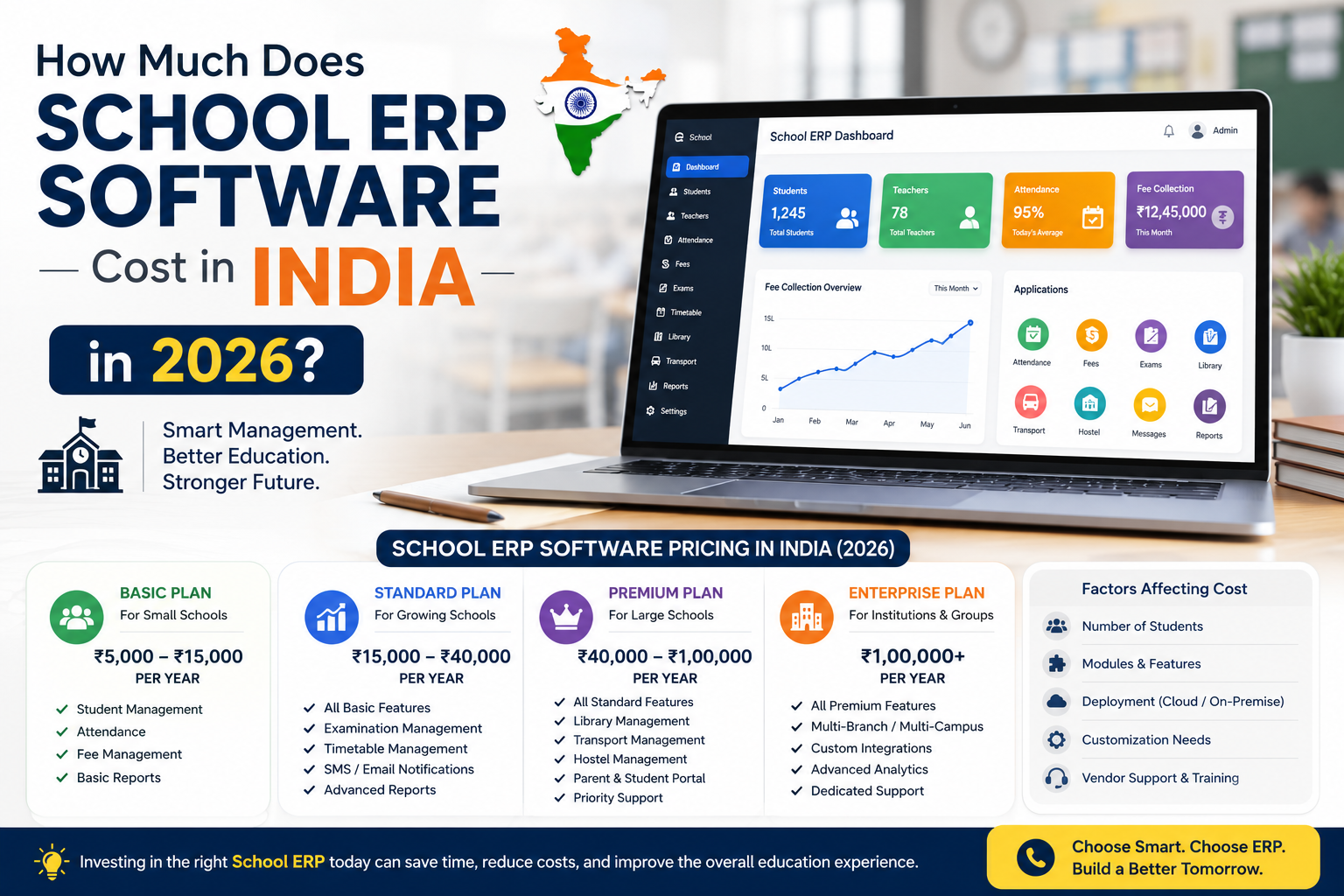
School ERP software in India typically costs between ₹10,000 and ₹35,000 per year for schools with 200 to 500 students on cloud-based plans, with pricing scaling by student count, staff count, and how many modules are included. Larger schools or institutions needing custom branding, multiple campuses, or advanced modules usually move to a custom-priced package. The real number depends less on the vendor's name and more on which features are actually included at each tier, which is what most pricing pages don't make clear upfront.
This guide breaks down actual pricing structures, what's typically bundled versus billed separately, and the questions to ask before signing an annual contract, so you're budgeting against real numbers instead of a vendor's opening quote.
What Determines the Price of School Management Software in India
Five factors move the price more than anything else:
-
Student and staff limits. Most vendors price by tiers based on how many student and staff accounts you need, not a flat fee regardless of school size.
-
Feature depth. A basic plan usually covers attendance, timetable, and academics. Fees management, exam management, ID card generation, transportation tracking, and a chat module are frequently reserved for higher tiers.
-
Deployment model. Cloud-based online school management systems are billed as an annual subscription. On-premise software usually means a higher upfront license cost plus ongoing server and IT maintenance.
-
Support and training. Onboarding help, staff training sessions, and response-time guarantees vary by plan and sometimes cost extra.
-
Customization and branding. Custom domains, school branding on the parent app, and white-labelled communication are typically premium-tier or custom-quote features.
Typical Pricing Tiers for School ERP Software
Pricing structures vary by vendor, but most cloud-based school administration software in India follows a similar tiered pattern. As a reference point, here's how LMScloud structures its plans:
|
Plan |
Student limit |
Staff limit |
Annual price |
What's typically included |
|
Digital Starter |
200 |
10 |
₹10,000 |
Core student, academics, teacher, timetable, and attendance management |
|
Smart School |
300 |
15 |
₹19,000 |
Everything in Starter, plus exam management, staff management, fees management, and school gallery |
|
Complete Digital School |
500 |
25 |
₹35,000 |
Full feature set, including ID card generation, website management, chat module, and transportation module |
|
Custom |
Based on need |
Based on need |
Custom quote |
Tailored feature set for larger schools or multi-campus institutions |
These figures reflect one vendor's published pricing as of July 2026 and are meant to illustrate how tiering typically works. Always request current pricing directly, since plans and inclusions are revised periodically.
What's Usually Included vs What Costs Extra
Reading a pricing page quickly can be misleading, because "management software" at the entry tier and "management software" at the top tier often mean very different feature sets.
|
Commonly included even at entry tier |
Commonly reserved for higher tiers |
|
Student management |
Fees management |
|
Academics and teacher management |
Exam management |
|
Timetable management |
Staff and staff leave management |
|
Attendance management |
ID card and certificate generation |
|
Assignment and announcement management |
Website management |
|
Chat module |
|
|
Transportation module |
If fee collection, exam result publishing, or transport tracking matter to your school on day one, confirm which tier actually includes them before comparing headline prices across vendors.
Cloud-Based vs On-Premise: Cost Differences
Most schools evaluating a school management system in India today are comparing cloud-based options, but it's worth understanding why the pricing models differ.
-
Cloud-based online school management system: Predictable annual subscription, no server hardware to buy or maintain, automatic updates, and access from any device. Cost scales with student and staff count.
-
On-premise school ERP software: Higher upfront cost for licensing and server setup, plus ongoing IT maintenance, security patching, and backup management handled in-house. This model has become less common as cloud infrastructure has matured, but some larger institutions with existing IT teams still prefer it.
For most schools under 1,000 students, a cloud subscription works out cheaper on a total-cost-of-ownership basis, since it removes server maintenance and in-house IT overhead from the equation.
Hidden Costs to Ask About Before You Sign
These are the charges that turn a reasonable quote into a surprising invoice:
-
Data migration. Moving existing student, staff, and academic records from registers or spreadsheets into the new system sometimes carries a setup fee.
-
Training sessions. Basic onboarding is often included, but extended or repeat training for staff may be billed separately.
-
Overage charges. Exceeding your plan's student or staff limit mid-year usually triggers a per-account charge or forces an upgrade.
-
Mobile app access. Confirm whether the parent, student, and teacher apps are included in the base price or licensed separately.
-
Branding and customization. Custom domains or white-labelled apps are almost always a premium-tier or custom add-on, not a base-plan feature.
-
Renewal pricing. Ask whether your first-year rate is an introductory price, since renewal pricing sometimes differs from the initial quote.
Is Free School Management Software Worth It?
Free and open-source school management tools exist, and they can work for very small schools with minimal requirements. But before choosing free software, weigh the trade-offs:
-
Support. Free tools typically offer community forums instead of dedicated support, which matters when attendance or fee data has an issue during an active school day.
-
Security and data ownership. Paid platforms generally invest more in encrypted infrastructure and defined data-handling policies. Confirm this explicitly for any free tool before uploading student data.
-
Feature ceilings. Free plans often cap student counts or lock core modules like fees or exam management behind a paid upgrade anyway, so the "free" plan may not stay free once your school scales.
-
Long-term reliability. A free tool maintained by a small community carries more risk of being discontinued than a commercially supported school ERP platform.
How to Budget for School ERP Software: A Quick Checklist
-
Get a realistic student and staff count, including expected growth over the next one to two academic years, not just current enrollment.
-
List must-have modules versus nice-to-have ones. Fees and exam management are essential for most schools; a chat module or custom branding may not be.
-
Ask for total cost of ownership, including setup, migration, training, and renewal pricing, not just the first-year sticker price.
-
Request a demo or trial before committing to an annual plan, so staff can confirm the interface actually fits daily workflows.
-
Compare per-student cost across tiers, not just the headline annual price, since a higher-tier plan can work out cheaper per student once your school crosses a certain size.
If you're still comparing what counts as school administration software versus a broader online school management system, this related guide on school administration software vs online school management system breaks down the terminology. For a fuller evaluation framework beyond pricing, see the best school ERP software buyer's checklist, and for common pitfalls to avoid during the buying process, this piece on mistakes schools make choosing school ERP software is worth reading before you sign anything.
Frequently Asked Questions
How much does school management software cost per student in India?
It varies by vendor and tier, but on plans like LMScloud's Complete Digital School package, the annual cost works out to roughly ₹70 per student at the 500-student limit, with lower tiers costing more per student due to smaller limits and fewer included features.
Is there a free school ERP software option for Indian schools?
Free and open-source options exist, but they typically come with limited support, capped student counts, or core modules like fees and exam management locked behind a paid upgrade. Evaluate the trade-offs before relying on a free tool for critical student data.
What's included in a basic school ERP plan versus a premium one?
Basic plans typically cover student, academics, teacher, timetable, and attendance management. Premium plans usually add fees management, exam management, staff management, ID card generation, a chat module, and transportation tracking.
Does school ERP software pricing scale with student count?
Yes. Most vendors price in tiers based on student and staff limits, so a 200-student school and a 500-student school pay different rates, and exceeding your tier's limit usually requires an upgrade or triggers an overage charge.
Are there hidden costs in school ERP software pricing?
Often, yes. Data migration, extended training, mobile app access, custom branding, and renewal pricing can all fall outside the headline annual price. Ask for a full cost breakdown before signing.
Is cloud-based school ERP software cheaper than on-premise software? For most schools under 1,000 students, cloud-based software works out cheaper on a total-cost-of-ownership basis, since it removes server hardware, in-house IT maintenance, and manual backup management from the cost equation.
See Real Pricing and Try a Demo
Compare plan details on the LMScloud pricing page, explore the full feature list on the features page, or try the live demo school before requesting a custom quote.