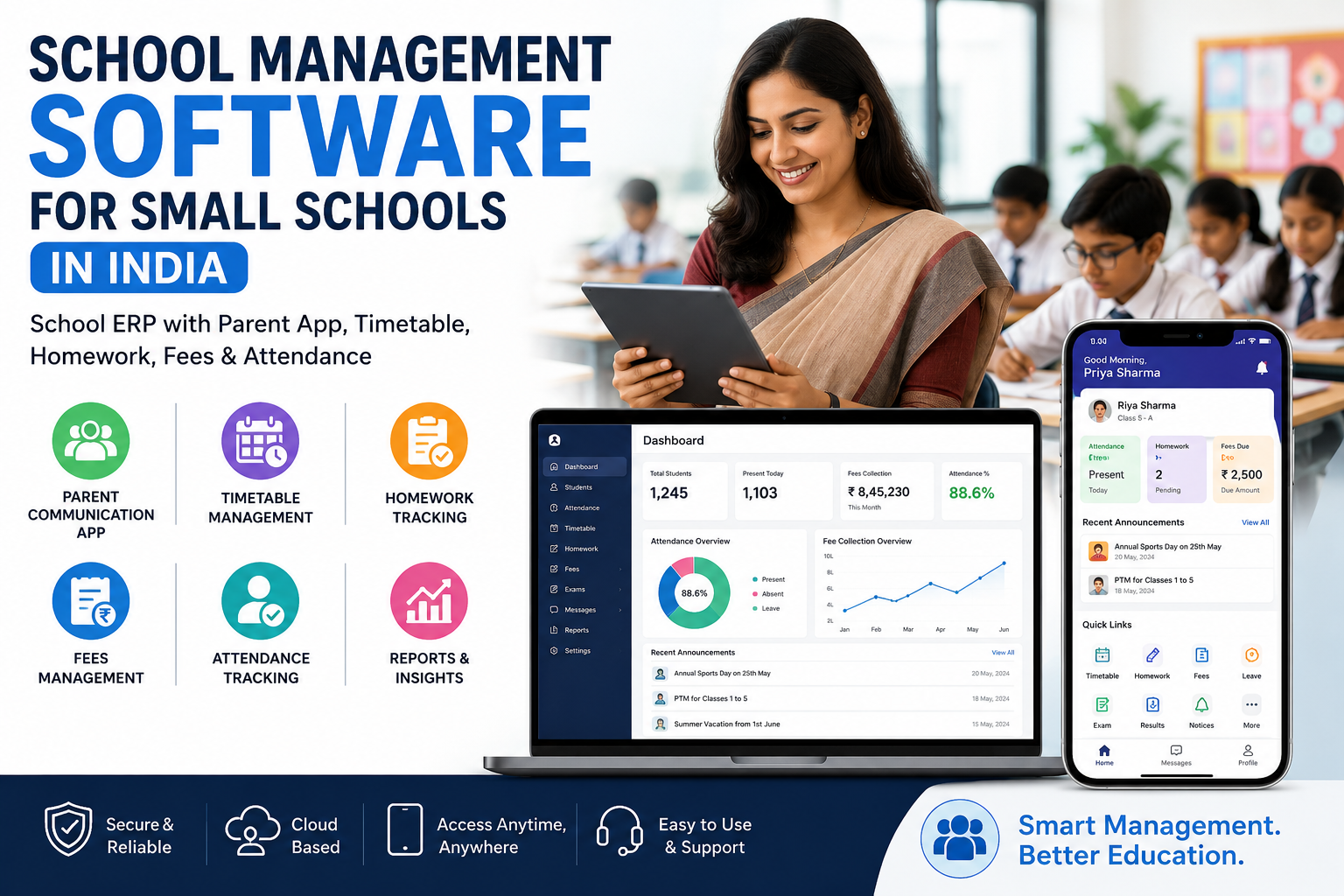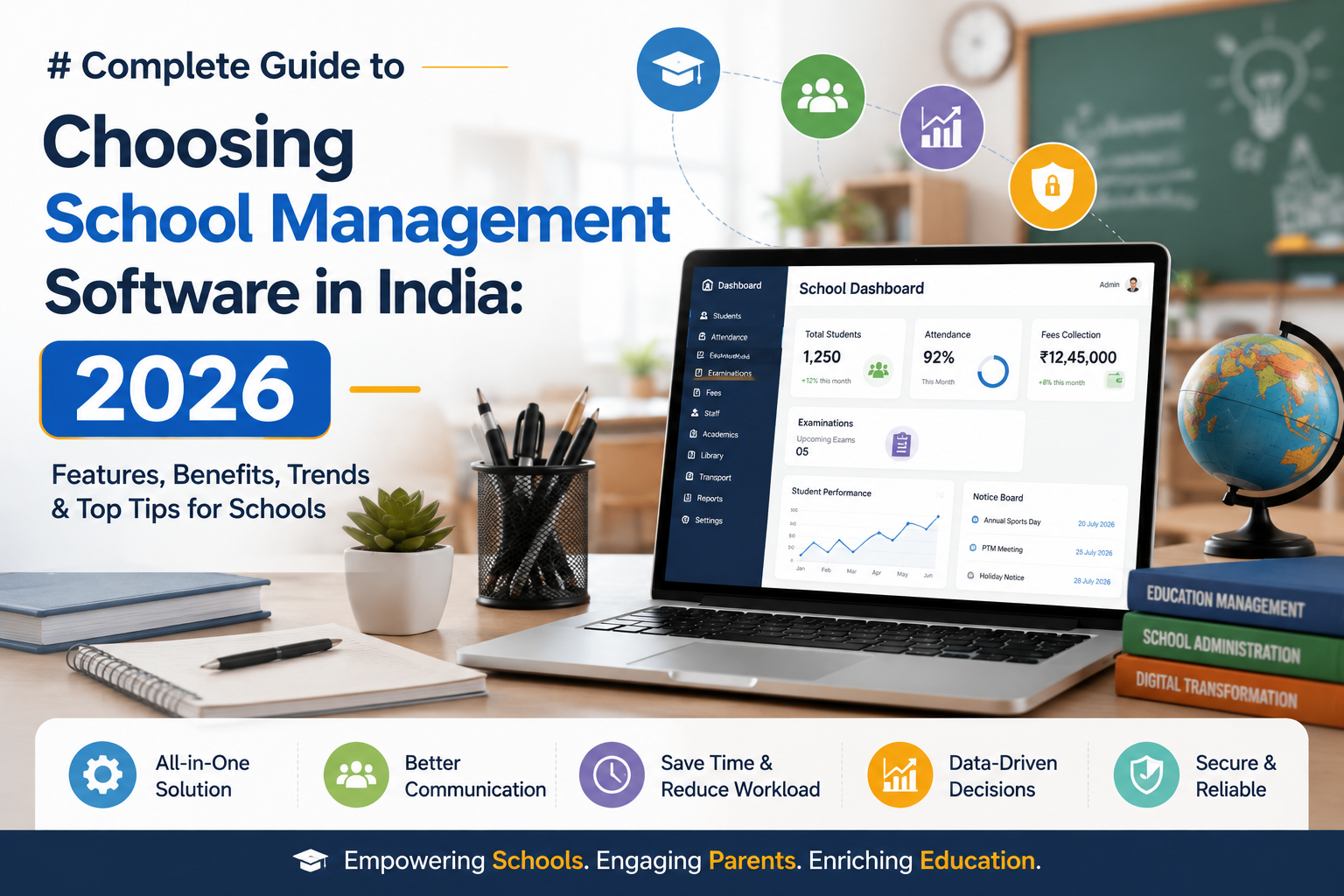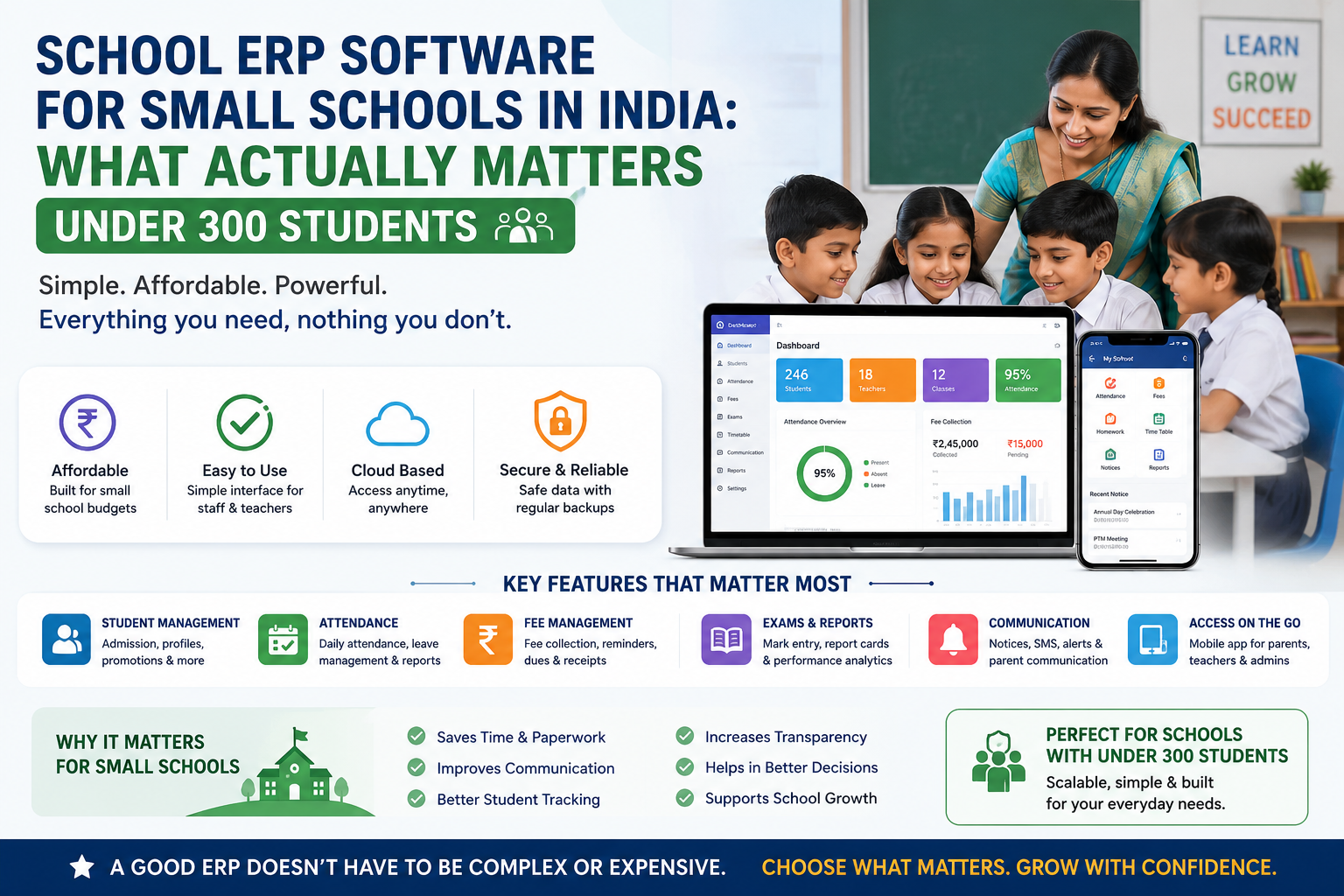
Quick answer: A small school (roughly under 300 students) doesn't need the same feature checklist a 2,000-student, multi-branch institution needs. Core modules like attendance, fees, exams, timetable, and parent communication matter more than transportation tracking, multi-branch dashboards, or heavy customization. Expect to pay somewhere in the ₹10,000 to ₹20,000 per year range for a genuinely cloud-based platform at this size, not the ₹35,000+ plans built for larger schools.
Most articles about the best school ERP software in India are written for the general case, a mid-to-large school comparing vendors on features, security, and scalability. If you're running a school with 150, 220, or 280 students, a lot of that advice doesn't quite apply. You don't need everything on a 14-feature list. You need the handful of modules that actually save your office time, at a price that makes sense for your enrollment.
Why Small Schools Get a Different Answer on "Best"
India has roughly 3.1 lakh private schools, and a large share of them, especially newer schools, schools in tier 2 and tier 3 towns, and single-branch institutions, run well under 500 students. A platform built around multi-branch dashboards, elaborate customization, and enterprise-scale reporting isn't wrong, it's just solving a problem a small school doesn't have yet.
The better question for a small school isn't "which school administration software has the most features." It's "which online school management system covers our actual daily workload without charging us for modules we'll never touch."
Small School Priorities vs Large School Priorities
|
Priority |
Small School (Under 300 Students) |
Large / Multi-Branch School |
|
Core need |
Attendance, fees, exams, timetable, parent communication |
All of the above, plus transport, multi-branch oversight, advanced reporting |
|
Staff management complexity |
Single office team, simple role structure |
Multiple departments, layered permissions |
|
Setup priority |
Fast go-live, minimal training overhead |
Structured rollout across branches |
|
Pricing sensitivity |
High, cost per student matters a lot |
Lower, cost is justified by scale and efficiency gains |
|
Customization needs |
Low, standard features are usually enough |
Higher, often needs branding and workflow customization |
|
Add-ons like transport tracking, ID cards, chat modules |
Nice to have, often skipped in year one |
Frequently essential from day one |
Core Modules a Small School Shouldn't Skip
Regardless of budget, these five modules do most of the daily work for a small school and are worth prioritizing over anything else on a vendor's feature list:
-
Student and academics management. Admissions, student records, and class/section structure, the foundation everything else sits on.
-
Attendance management. Digital attendance for students (and ideally staff) replaces paper registers immediately, this is usually the fastest win a small school sees.
-
Fees management. Payment logs and receipts in one place, instead of a spreadsheet the office manager maintains manually.
-
Timetable management. Even a simple school benefits from a timetable that teachers and parents can actually see, instead of a printed sheet pinned to a noticeboard.
-
Exam management. Online or offline result entry that generates report cards, rather than typing marks into Word templates every term.
Features like transportation tracking, ID card generation, a chat module, or website management are genuinely useful, but they're reasonable to defer to year two once the core workflow is running smoothly. That's a different priority order than what most "best school ERP software" guides recommend, because those guides are usually written with a larger school in mind.
What This Actually Costs for a Small School
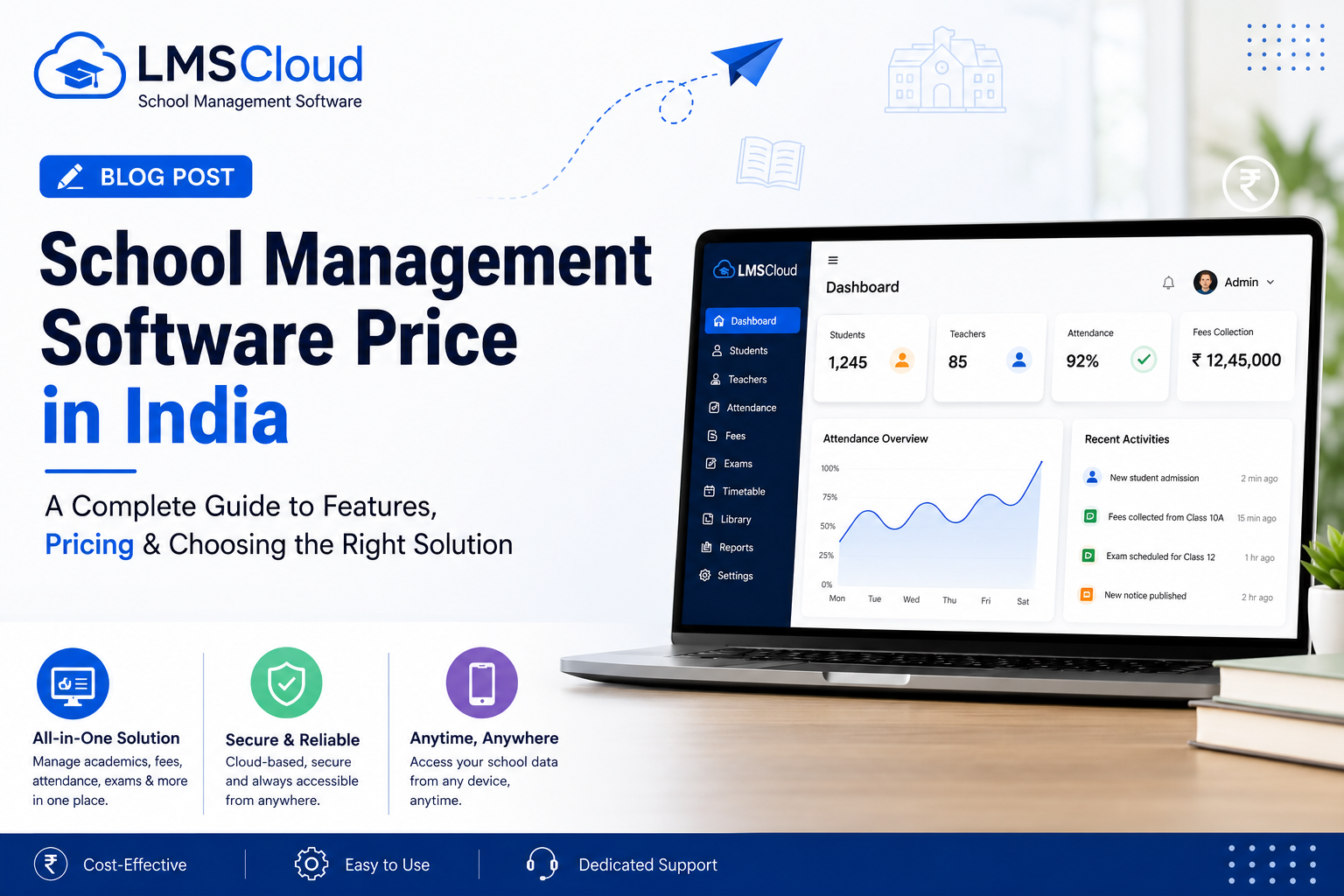
Pricing structured around student count matters more at this size than it does for a large school, because the difference between ₹10,000 and ₹35,000 a year is a real budget line, not a rounding error. Here's how LMSCloud's tiers map to small-school reality:
|
Plan |
Student / Staff Limit |
Price (per year) |
Fits a Small School? |
|
Digital Starter |
200 students / 10 staff |
₹10,000 |
Yes, if you can defer fees and staff management to next year |
|
Smart School |
300 students / 15 staff |
₹19,000 |
Yes, includes fees management, staff management, and exam management |
|
Complete Digital School |
500 students / 25 staff |
₹35,000 |
Usually oversized for under-300-student schools, better fit once you're closer to the cap |
A practical rule for a small school: the Smart School tier is usually the sweet spot, since it adds fees management, staff management, and exam management over the Digital Starter tier without paying for transportation tracking, ID card generation, or website management you may not need yet. For the full module-by-module cost breakdown, see our detailed school ERP pricing guide.
Common Mistakes Small Schools Make When Choosing an ERP
-
Buying the biggest plan "to be safe." Paying for a 500-student tier while running 180 students means paying for headroom you won't use for years.
-
Skipping the demo. A feature list looks the same on every vendor's website. A live demo school account shows you whether the actual workflow fits how your office works.
-
Ignoring setup time. If a vendor can't tell you clearly how long onboarding takes with your real data, that's worth asking about directly before signing anything.
-
Treating "school administration software" and "online school management system" as different products. In current products, they're the same category with different marketing labels. What matters is the module list, not the name on the homepage. We break this down in more detail in our school administration software vs online school management system comparison.
For a longer list of what tends to go wrong, our post on common mistakes schools make choosing ERP software covers several more that apply regardless of school size.
How Setup Works for a Small School
Smaller student and staff counts generally make onboarding faster, not slower. Most schools on a cloud platform go live within 5 to 7 working days, provided student, staff, and academic session data is ready to upload. For a school under 300 students, that data entry step is usually the fastest part of the whole process, since there's simply less of it to migrate compared to a larger institution.
Frequently Asked Questions
Is a small school better off with school administration software or a full online school management system?
In practice, there's little difference between the two labels in current products. What matters is whether the platform covers attendance, fees, exams, timetable, and communication in one place, regardless of what the vendor calls it.
What's the best school ERP software in India for a school under 300 students?
There's no universal answer, but the right fit is a cloud-based platform with transparent, student-count-based pricing that lets you start with core modules (attendance, fees, exams, timetable) and add features like transport or ID cards later, rather than paying for a large-school feature set upfront.
How much does school ERP software cost in India for a small school?
For a school under 300 students, expect to pay somewhere between ₹10,000 and ₹20,000 per year for a cloud-based platform with core modules included, based on current 2026 pricing from providers like LMSCloud.
Do small schools really need a mobile app for parents?
Usually yes, even at small scale, since parent communication (announcements, attendance visibility, fee reminders) is often the single biggest time-saver a school gets from switching off paper and WhatsApp groups.
Should a small school wait until it grows before switching to an ERP?
No, the opposite is usually true. Digitizing attendance, fees, and communication early means there's no painful mid-year migration later, and the switch is far simpler with 150 students than it would be with 800.
Final Word
Most "best school ERP software" content is written for the general case. If you're running a school under 300 students, the better filter isn't the longest feature list, it's the shortest list of modules that actually replace your registers, spreadsheets, and WhatsApp groups, at a price that fits your enrollment. Start with the core five, add the rest when you actually need them.
Ready to see it running on real data? Try the demo school or register your school to compare the Digital Starter and Smart School tiers against your actual student count.